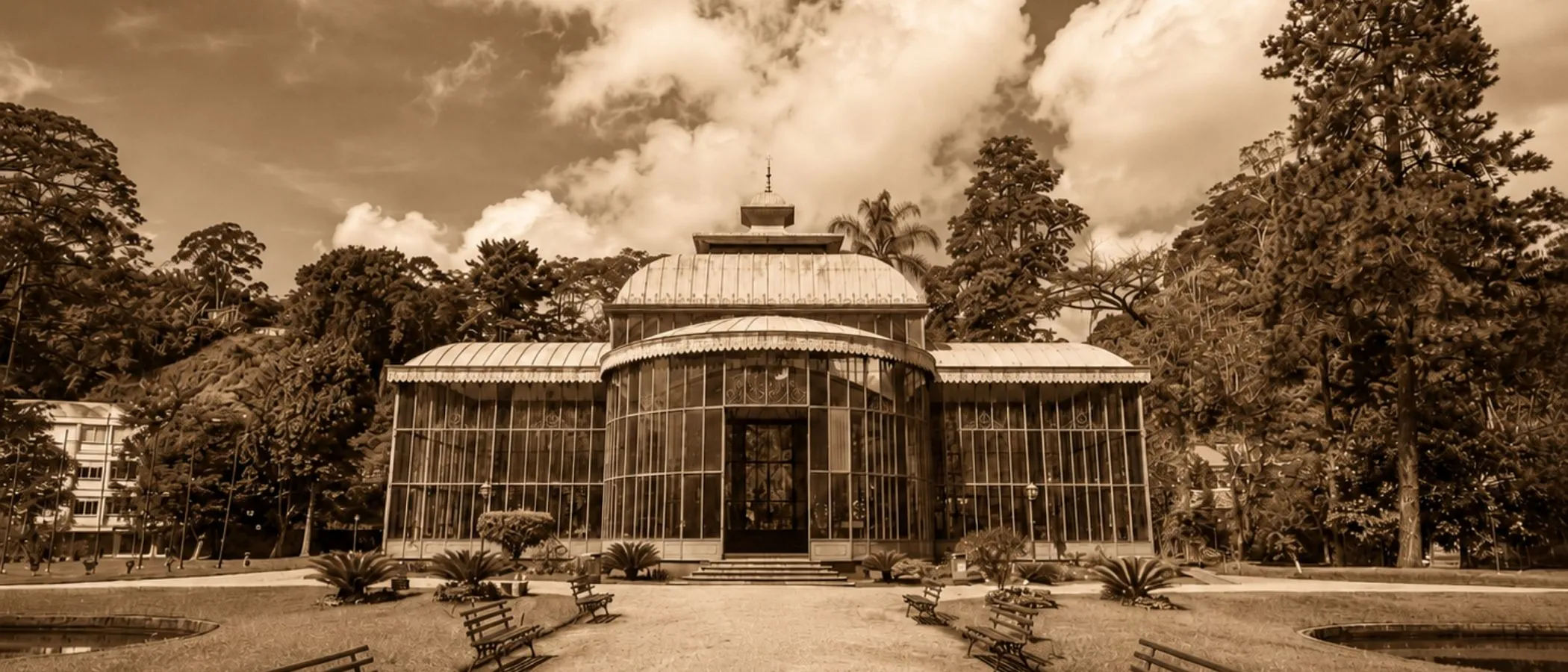
The Mountain City That Always Knew Its Worth
Between palaces, summer residences and properties surrounded by the Atlantic Forest, Petrópolis has spent nearly two centuries attracting families with the freedom to choose where and how they wanted to live. That history continues to shape the city’s luxury real estate market.
Petrópolis was already a prestigious address long before Brazil had an established luxury property market. The city began with a personal preference of Emperor Pedro I, became the summer residence of Pedro II and, over the following decades, attracted members of the imperial aristocracy, diplomats, business leaders, politicians and prominent families from Rio de Janeiro.
After being captivated by the region’s climate and landscape, Pedro I purchased the Córrego Seco estate in 1830. The property was later inherited by Pedro II, who signed the decree establishing Petrópolis on 16 March 1843. Construction of the Imperial Palace began two years later, and the residence soon became the emperor’s preferred summer retreat.
The decision followed a logic that remains familiar today: proximity to Rio de Janeiro, cooler temperatures, abundant greenery and enough distance from the capital’s daily pressures. The mountains offered a change of setting without requiring a complete separation from the political, economic and social life of the Imperial Court.
A city designed to receive guests developed around the palace. During the imperial season, Petrópolis welcomed titled members of the nobility, foreign representatives and major landowners. Historical records reveal the presence of numerous barons, viscounts and counts who lived or maintained seasonal residences in the city, forming a summer aristocracy that occupied houses and palaces in its most desirable areas.
These were not merely occasional visits. Owning or maintaining a home in Petrópolis was also a statement of social position. Residences were used to host guests, organise gatherings and follow the seasonal movement of the imperial family. By the nineteenth century, the city had already developed a residential culture that would now be described as second-home living.
Among the most significant figures associated with this period was Irineu Evangelista de Sousa, the Baron and later Viscount of Mauá. A banker, industrialist and entrepreneur involved in railways, shipping and some of Brazil’s earliest large-scale infrastructure projects, Mauá purchased land for a summer residence in Petrópolis in 1852. A decade later, travellers were already describing his palace as one of the city’s notable homes.
Mauá’s presence broadens the understanding of Petrópolis. The city was not chosen only by titled nobles and members of the Imperial Court. It also attracted Brazil’s emerging economic elite: bankers, industrialists, merchants and families whose fortunes were built during the Empire and the early Republic.
The surnames changed, but the habit remained. By the 1930s, the press was still closely following the Petrópolis social season. Period photographs and reports featured the residences of Luiz da Rocha Miranda and Octávio Guinle, two names associated with the economic and social elite of the time, alongside palaces, embassies and the movement of seasonal residents throughout the city.
Octávio da Rocha Miranda also took part in the organisation of Petrópolis’s former Tourism Syndicate, an institution largely managed by summer residents interested in promoting the city and coordinating its social calendar. Its circles included presidents, diplomats, writers, scientists and business leaders.
Santos Dumont found in Petrópolis an address that suited his character. In 1918, he purchased a steep plot on Rua do Encanto and designed his own summer house. Known as A Encantada, the residence was small, functional and inventive, with multipurpose furniture, unusual staircases and domestic solutions created by the aviator himself. It remains an intimate portrait of a man who could have chosen grandeur but preferred a highly personal home surrounded by the Petrópolis landscape.
During the first half of the twentieth century, the Quitandinha Palace gave the city’s social life a new scale. Opened in 1944, it was one of the largest casino hotels in the Americas. Its vast salons hosted Brazilian and international personalities, including Carmen Miranda and Walt Disney. In 1947, the building hosted the Inter-American Conference for the Maintenance of Continental Peace and Security.
The casino era was brief. Gambling was banned in Brazil in 1946, and the Quitandinha was eventually converted into a residential condominium. The building nevertheless remained a physical reminder of a period when Petrópolis was simultaneously a mountain retreat, a political stage and a centre of entertainment.
Why Petrópolis Is Still Chosen
The market has changed, but the reasons for choosing Petrópolis are not as different as they may appear.
For buyers seeking a primary residence outside Rio de Janeiro, the city offers a complete urban structure without the scale and pressure of a metropolis. There are schools, healthcare services, restaurants, shops and access to the capital, as well as houses with gardens, quieter streets and neighbourhoods where the Atlantic Forest remains part of everyday life.
Security also carries weight in this decision. Recent studies based on official mortality and population data have placed Petrópolis among the safest large municipalities in the state of Rio de Janeiro. Individual neighbourhoods naturally differ, but the broader perception of safety remains an important factor for families considering a move away from the capital.
For second-home buyers, the motivation is different. The house becomes the centre of the weekend: a lit fireplace, a long lunch, a garden that matures over time and bedrooms prepared for children, relatives and friends. It is not a property purchased merely to be admired. It must work well and become more meaningful with age.
Itaipava concentrates the best-known expression of this market, combining gated communities, restaurants, retail and an established weekend social scene. Araras offers a quieter interpretation, with homes integrated into the forest and architecture designed around the terrain. Secretário has attracted buyers interested in country properties, lower density and greater privacy. Brejal preserves a more open rural landscape, defined by farms, agricultural production and properties located away from the busier commercial centres.
In each of these areas, luxury does not necessarily depend on ostentation. It may be found in the position of the land, an uninterrupted view, a mature garden, architecture that respects the landscape or the possibility of maintaining genuine distance from neighbouring properties.
There is also a factor that is difficult to capture in spreadsheets: continuity. Many real estate destinations emerge quickly, supported by new developments, marketing campaigns and newly fashionable commercial districts. Petrópolis has a residential history that predates the modern concept of a luxury property market.
The city has lived through the fall of the Empire, the establishment of the Republic, the end of casino gambling and several economic cycles. It has nevertheless continued to attract families, entrepreneurs, artists and buyers interested in living or maintaining a home in the mountains.
Someone purchasing a luxury property in Petrópolis today is not reproducing the life of the old aristocracy. The buyer is, however, answering a remarkably similar question: where is it possible to remain close to Rio de Janeiro while enjoying more space, a cooler climate, nature and privacy?
For almost two centuries, many people have arrived at the same answer.